dinglimachine01@gmail.com
+86 16638159081(Wechat/WhatsApp)
dinglimachine01@gmail.com
+86 16638159081(Wechat/WhatsApp)

Empty fruit bunches (EFB) are one of the major biomass residues generated by the palm oil industry. With large quantities available in palm oil-producing regions, EFB can be converted from a low-value agricultural residue into carbon-rich biochar through controlled pyrolysis and carbonization. Recent research has highlighted the potential of EFB as a feedstock for biochar, solid fuel and other value-added carbon products.
Our EFB continuous carbonization line is designed to provide a practical solution for large-scale EFB utilization. The production process can integrate EFB preparation, drying, continuous feeding, carbonization, combustible gas utilization, cooling and biochar collection. Before carbonization, the EFB is prepared to achieve suitable moisture and feedstock conditions. It then enters the carbonization system continuously, where controlled heating in an oxygen-limited environment converts the biomass into carbon-rich biochar.
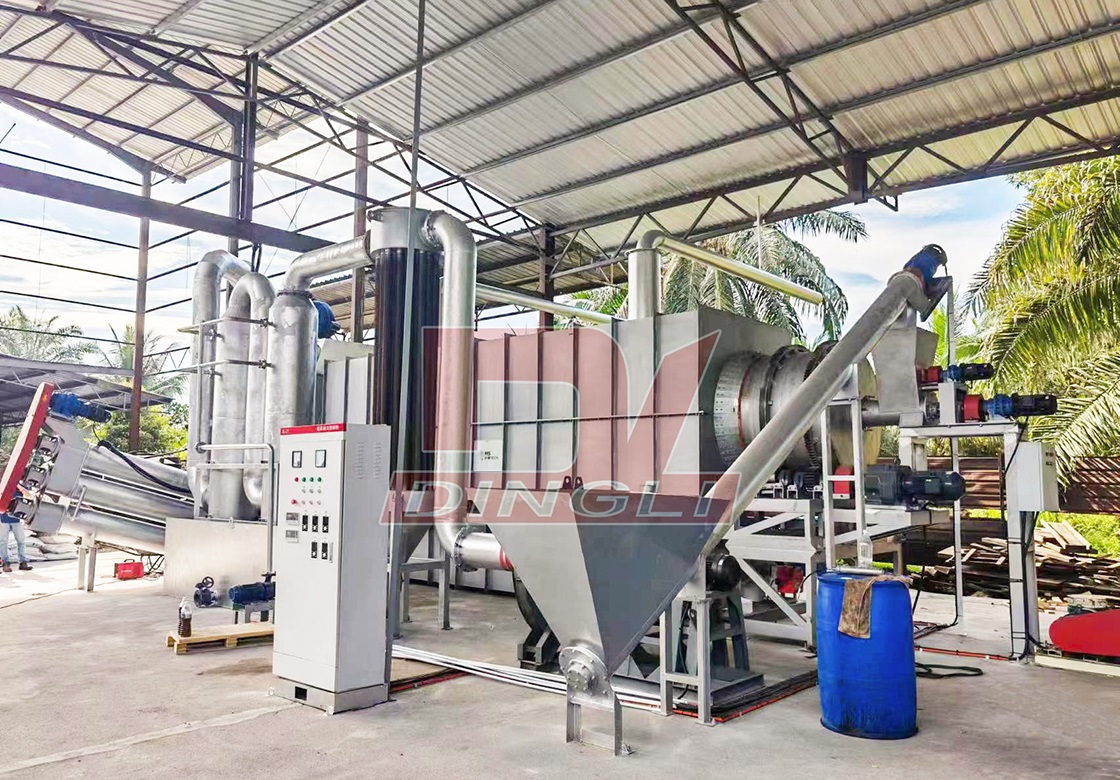
The resulting EFB biochar can be further processed according to the customer's requirements. Potential applications include soil amendment, biochar fertilizer, solid biofuel, adsorbent materials and other carbon-based products. For palm oil mills and biomass processing companies, an EFB continuous carbonization line provides a pathway to reduce biomass waste while producing a useful carbon product. By locating the carbonization system close to the source of EFB, transportation and biomass handling can also be integrated into the overall project design.
Dingli Group provides customized EFB continuous carbonization equipment and complete production-line solutions, with the system configuration adjusted according to raw material characteristics, processing capacity, moisture content and final biochar application. The solution is suitable for palm oil-producing regions where EFB is available in large quantities and where biomass valorization is an important part of the project.
I would like to ask for a price quotetion for DLTJ2212.
Hello. How much is your "DLTJ1912" model?
Please send offer for biochar making machine with all technicals spécifications
We are in need of a rice husk charcoal machne for bio coal making.
We are intrested in contiunous carbonization machine, we need a high capacity.
We are interested in biomass pyrolysis machine 2 tons per hour .
Interested in wood charcoal machine. what price and size of wood it creates?